01
Tell us
Start with how you feel.
A short, considered questionnaire — energy, cycle, sleep, history. No symptom-checker drama.
Bloodwork intelligence for women
Plain-English guides to blood tests, biomarkers and the women's health questions most clinics never explain properly.
Educational only. Not medical advice.
Bloodwork can surface real clues about energy, mood, hormones, cycle health, skin, hair, metabolism and long-term risk. But results arrive as ranges, abbreviations and vague "normal" flags — often without the context that would make them useful.
Heme turns the key markers into plain-English explanations, so you can understand what's worth discussing with a qualified healthcare provider — and walk into your next appointment with better questions.
Six ways in. Each one points to the markers worth asking about.
Iron, thyroid, B12, vitamin D — the four most-overlooked drivers of "just tired."
Explore → SymptomFerritin, thyroid, vitamin D — the bloodwork patterns most often behind telogen effluvium.
Explore → SymptomFerritin, CBC, iron panel, thyroid — what to ask if cycles are draining you.
Explore → StageThe 5–10 hormone-shift years most clinics miss entirely — and the labs worth asking for.
Explore → DecodePlain-English guides to 14 biomarkers — ferritin, TSH, estradiol, B12, vitamin D and more.
Explore → CompareFunction Health, LetsGetChecked and traditional labs — scored on the same framework.
Explore →How women actually feel rarely shows up in a single test. Heme connects the symptom to the markers worth understanding.
Not a diagnosis — a clearer starting point. Take the Heme Check →
No diagnoses. No noise. A quiet, editorial walk from how you feel to the right test, in plain English.
A short, considered questionnaire — energy, cycle, sleep, history. No symptom-checker drama.
We point you to the panel that may surface the answers — and the questions worth asking your doctor.
Ferritin, TSH, estradiol — what each number means for you, without the medical jargon.
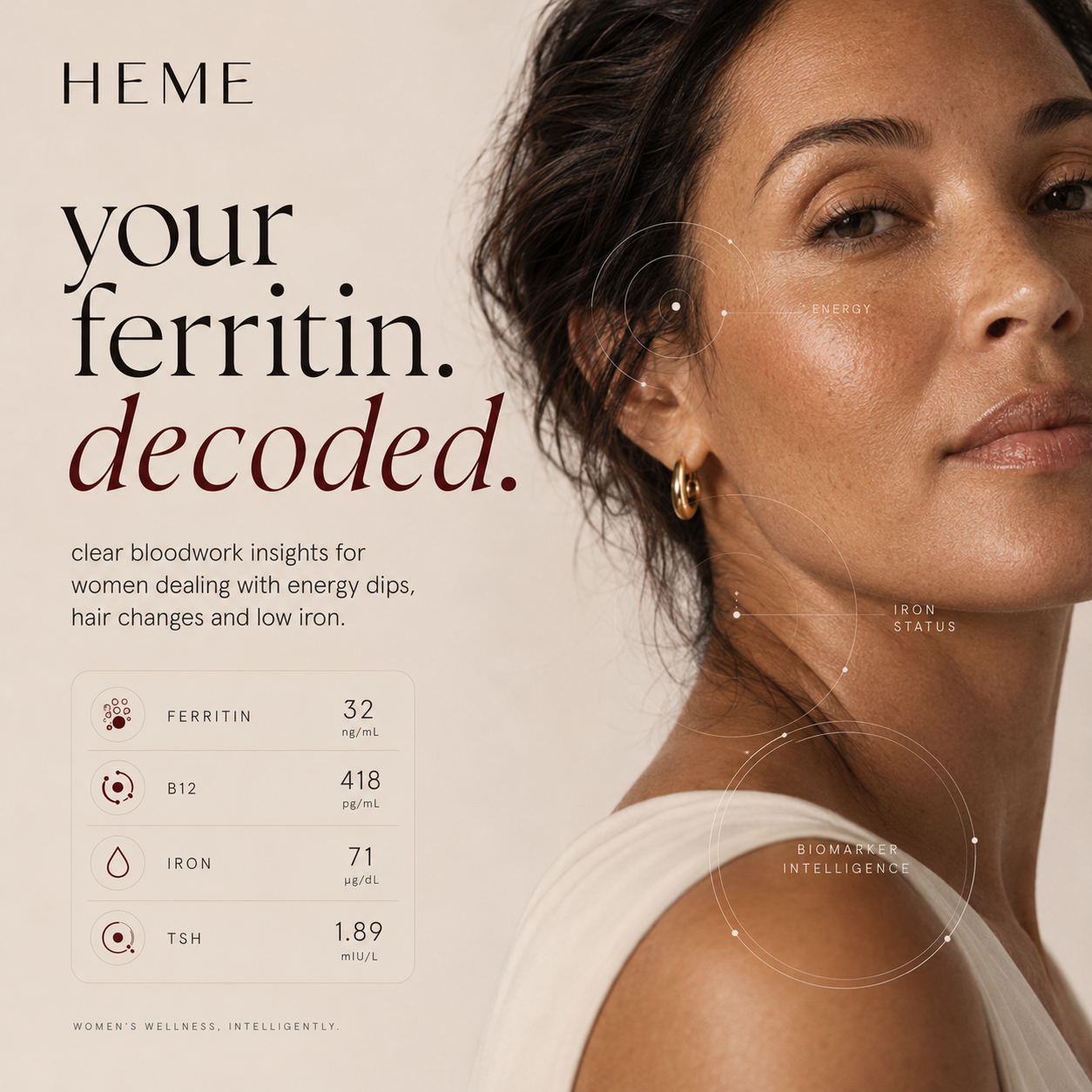
This is what a typical bloodwork printout looks like — and what a Heme translation adds.
Within the lab range, but at 18 ng/mL you sit in the bottom 8% — below where most women in your age group feel like themselves.
Not a diagnosis — a clearer starting point. Take the Heme Check →
A preview of what arrives after the Heme Check — your numbers, decoded with care. No diagnoses. Just clearer questions.
We looked at 14 markers across iron, thyroid, vitamins and hormones. These three are the ones we’d flag as worth a conversation with a qualified healthcare provider.
Below the level where most women feel like themselves.
Within range, but at the edge that may be worth re-testing.
Common in cooler months · may relate to mood and energy.
Your fatigue may be a story your iron stores and vitamin D are telling together. Heavy periods are the most common cause of low ferritin in women your age — and the thyroid result is worth keeping an eye on.
This is a sample. Yours will be based on your numbers, your story.
Take the Heme Check →Energy, mood, cycle, skin, metabolism. The numbers translated.
Move the marker. Read what your number may mean.
Low end of typical range. Many women in this band describe fatigue, shortness of breath, or hair shedding.
Educational only. Not medical advice.
Scored on the same seven-criterion framework Heme uses across every comparison page.
Pattern worth noticingFerritin low end + luteal progesterone trending below typical. Worth raising at your next appointment.
Where your number sits. What may be worth raising. Never a diagnosis.
menstruating U.S. women meets clinical criteria for heavy menstrual bleeding — yet ferritin is rarely tested at the annual visit.
Read the guideof women in perimenopause are unaware they're in it — symptoms are routinely attributed to stress, sleep or motherhood.
Decode perimenopauseexplain a meaningful share of the energy, mood, cycle and metabolic concerns women describe in primary care visits.
Explore biomarkersThe markers worth knowing shift with each stage. Heme moves with you.
Mid-luteal progesterone, estradiol patterns and what a "normal" cycle could look like for you.
ExploreThe 5–10 years before menopause. The hormone shifts most women are told are "just stress".
ExploreIron, thyroid and the after-birth biomarkers that may explain the fog 12+ months later.
ExploreAMH, day-3 panels and the markers worth knowing if you're thinking ahead — solo or as a couple.
ExploreThe four most common biomarker drivers of "just tired" — and the panel worth asking for.
ExploreHormonal acne, hair shedding and the nutrient + hormone patterns behind them.
ExploreThyroid, vitamin D, B12 and the cycle-tied patterns that may explain mood shifts.
ExploreThe modern panel — ApoB, Lp(a), hsCRP, fasting insulin — worth asking for earlier rather than later.
ExplorePlain English. Carefully reviewed. Never diagnostic.
Iron and ferritin are not the same number. What to ask for, plainly.
TSH alone misses too much. The full panel worth asking for.
The 5–10 hormone-shift years most clinics miss entirely.
An estimated 1 in 5 menstruating U.S. women quietly meets clinical criteria.
Seven criteria, head-to-head. No paid placement.
Three minutes in. Markers, tests and questions worth bringing to your provider out.
Energy, cycle, mood, hair, skin — your context, in your own words.
A short list of markers most relevant to where you are right now.
Plain-English prompts to bring to a qualified healthcare provider.
Slow, careful writing on the questions women are left to figure out alone.
Iron and ferritin are not the same number. We unpack why most U.S. annual physicals don't check the marker most likely to explain women's fatigue — and what to ask for, in plain English, at your next appointment.
Same seven criteria. Published methodology. No paid placement.
110+ biomarkers, $499/year. The most comprehensive at-home panel in the U.S. — best for women who want a yearly deep dive.
Single-condition panels (iron, thyroid, women's health) with nurse follow-up. Best for targeted, repeat testing rather than full annual.
The four iron forms worth comparing, the bioavailability claims worth ignoring, and the brands that hold up to scrutiny.
A small number of category-leading brands work with Heme each year — through sponsored editorial, the Heme Reviewed badge program, lead-gen partnerships and newsletter sponsorship. Independence, methodology and disclosure are non-negotiable.
Partner with HemeEducational only. Not medical advice. Heme is an editorial comparison platform and does not provide medical diagnosis, treatment or emergency advice. Always speak to a qualified healthcare provider about symptoms, blood results or treatment decisions. Some links on this site are affiliate links — they may earn us a small commission at no cost to you. How we make money.